‘The Journey’, by Mary Oliver

One day you finally knew
what you had to do, and began,
though the voices around you
kept shouting
their bad advice–
though the whole house
began to tremble
and you felt the old tug
at your ankles.
‘Mend my life!’
each voice cried.
But you didn’t stop.

You knew what you had to do,
though the wind pried
with its stiff fingers
at the very foundations,
though their melancholy
was terrible.
It was already late
enough, and a wild night,
and the road full of fallen
branches and stones.

But little by little,
as you left their voices behind,
the stars began to burn
through the sheets of clouds,
and there was a new voice
which you slowly
recognised as your own,
that kept you company
as you strode deeper and deeper
into the world,
determined to do
the only thing you could do–
determined to save
the only life you could save.
“Anthem”

by Leonard Cohen

The birds they sang
At the break of day
Start again
I heard them say
Don’t dwell on what
Has passed away
Or what is yet to be.
Ah the wars they will
Be fought again
The holy dove
She will be caught again
Bought and sold
And bought again
The dove is never free.

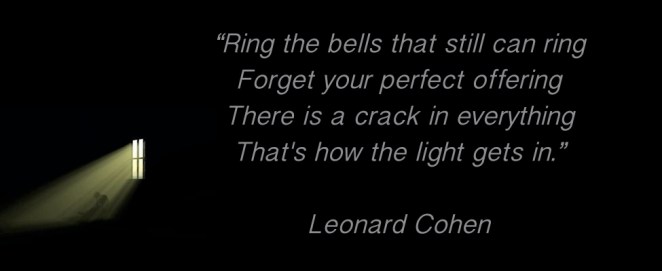
Ring the bells that still can ring
Forget your perfect offering
There is a crack in everything
That’s how the light gets in.

We asked for signs
The signs were sent
The birth betrayed
The marriage spent
Yeah the widowhood
Of every government
Signs for all to see.

I can’t run no more
With that lawless crowd
While the killers in high places
Say their prayers out loud.
But they’ve summoned, they’ve summoned up
A thundercloud
And they’re going to hear from me.

Ring the bells that still can ring

You can add up the parts
But you won’t have the sum
You can strike up the march,
There is no drum
Every heart, every heart
To love will come
But like a refugee.

Ring the bells that still can ring
Forget your perfect offering
There is a crack, a crack in everything
That’s how the light gets in.

Ring the bells that still can ring
Forget your perfect offering
There is a crack, a crack in everything
That’s how the light gets in.

Ode To Autmn

image

On This Day

September 19, 1819 – John Keats wrote “Ode to Autumn.”

image

Ode To Autumn

1.
Season of mists and mellow fruitfulness, 
        Close bosom-friend of the maturing sun;
    Conspiring with him how to load and bless
        With fruit the vines that round the thatch-eves run;
    To bend with apples the moss’d cottage-trees,
        And fill all fruit with ripeness to the core;
          To swell the gourd, and plump the hazel shells
        With a sweet kernel; to set budding more,
    And still more, later flowers for the bees,
  Until they think warm days will never cease,
          For Summer has o’er-brimm’d their clammy cells.

2.
  Who hath not seen thee oft amid thy store?
      Sometimes whoever seeks abroad may find
  Thee sitting careless on a granary floor,
      Thy hair soft-lifted by the winnowing wind;
  Or on a half-reap’d furrow sound asleep,
      Drows’d with the fume of poppies, while thy hook
          Spares the next swath and all its twined flowers:
  And sometimes like a gleaner thou dost keep
      Steady thy laden head across a brook;
      Or by a cyder-press, with patient look,
          Thou watchest the last oozings hours by hours.

3.
  Where are the songs of Spring? Ay, where are they?
      Think not of them, thou hast thy music too,—
  While barred clouds bloom the soft-dying day,
      And touch the stubble-plains with rosy hue;
  Then in a wailful choir the small gnats mourn
      Among the river sallows, borne aloft
          Or sinking as the light wind lives or dies;
  And full-grown lambs loud bleat from hilly bourn;
      Hedge-crickets sing; and now with treble soft
      The red-breast whistles from a garden-croft;
          And gathering swallows twitter in the skies.

SENSES
See
The light spilling through the trees
How it illuminates what lies ahead
Sense the beauty of the day
Hear
The sounds of birds and insects
Creation’s orchestral arrangement
Sense the music of the day
Smell
The pines’ crisp, tangy aroma
Damp and earthy tones
Sense the fragrance of the day
Taste
The damp, cool morning air
Fulfilling flavor of the woods
Sense the satisfaction of the day
Touch
The dew covered grasses
Blades both wet and sharp
Sense the impact of the day

Rick Lewis, June 22, 2014

Mother to Son

BY LANGSTON HUGHES

Well, son, I’ll tell you:
Life for me ain’t been no crystal stair.
It’s had tacks in it,
And splinters,
And boards torn up,
And places with no carpet on the floor—
Bare.
But all the time
I’se been a-climbin’ on,
And reachin’ landin’s,
And turnin’ corners,
And sometimes goin’ in the dark
Where there ain’t been no light.
So boy, don’t you turn back.
Don’t you set down on the steps
’Cause you finds it’s kinder hard.
Don’t you fall now—
For I’se still goin’, honey,
I’se still climbin’,
And life for me ain’t been no crystal stair.

Langston Hughes was an American poet, social activist, novelist, playwright, short story writer, and columnist. He was one of the earliest innovators of the then-new literary art form jazz poetry.

On Civil Rights

“I, too, sing America.

I am the darker brother.
They send me to eat in the kitchen
When company comes,
But I laugh,
And eat well,
And grow strong.

Tomorrow,
I’ll be at the table
When company comes.
Nobody’ll dare
Say to me,
“Eat in the kitchen,”
Then.

Besides,
They’ll see how beautiful I am
And be ashamed—

I, too, am America.”