
On This Day
August 10, 1927 – Mount Rushmore was formally dedicated. The individual faces of the presidents were dedicated later.
August 8, 1960 – 25,000 copies of “Tell Laura I Love Her” were destroyed by Decca Records. It was said that the song was “too tasteless and vulgar for English sensibility.”


On This Day
August 6, 1809 – Alfred Lord Tennyson is born in Somersby, Lincolnshire, England.
“Come, my friends.
‘T is not too late to seek a newer world.
Push off, and sitting well in order smite
The sounding furrows; for my purpose holds
To sail beyond the sunset, and the baths
Of all the western stars, until I die.
It may be that the gulfs will wash us down;
It may be we shall touch the Happy Isles,
And see the great Achilles, whom we knew.
Tho’ much is taken, much abides; and tho’
We are not now that strength which in old days
Moved earth and heaven, that which we are, we are,—
One equal temper of heroic hearts,
Made weak by time and fate, but strong in will
To strive, to seek, to find, and not to yield.”
August 4, 1735 – Freedom of the press was established with an acquittal of John Peter Zenger. The writer of the New York Weekly Journal had been charged with seditious libel by the royal governor of New York. The jury said that “the truth is not libelous.”

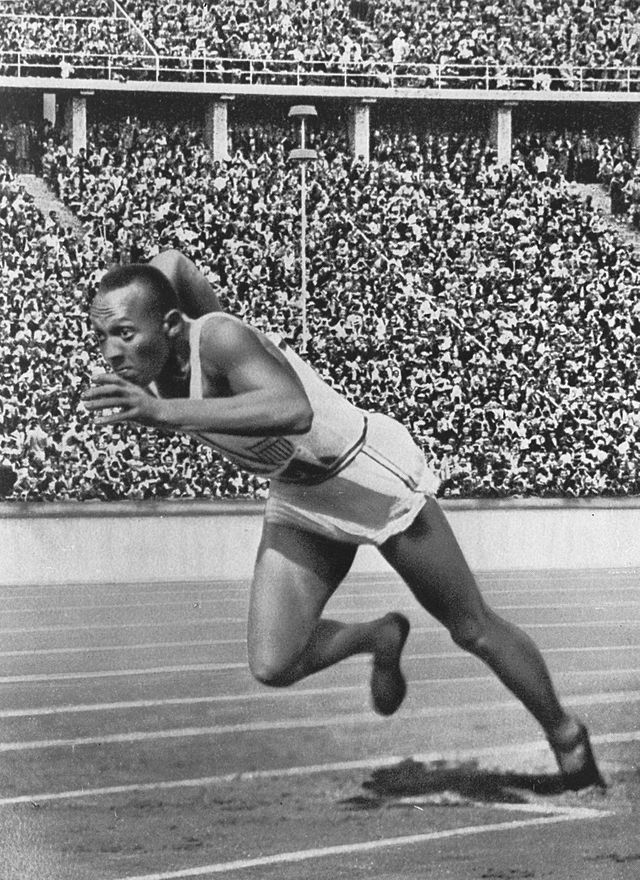
August 3, 1936: Jesse Owens Breaks Records at Berlin Olympics
On this day in 1936, African American sprinter, Jesse Owens, triumphed at the Berlin Olympics, winning his second of four gold medals at the games and discrediting Adolf Hitler’s theories on the superiority of the Aryan race. While many countries boycotted the Olympic Games that year, the United States brought 312 athletes – 19 African American and 5 Jewish – much to the reluctant approval of the Nazis.
Photo: Jesse Owens at start of record breaking 200 meter race during the Olympic games 1936 in Berlin. Wikimedia Commons

August 2, 1943 – The U.S. Navy patrol torpedo boat, PT-109, sank after being attacked by a Japanese destroyer. The boat was under the command of Lt. John F. Kennedy.
In July 1943, according to the official Navy report, Kennedy and the crew of PT 109 were ordered into combat near the Solomon Islands. In the middle of the night on August 2, their boat was rammed by a Japanese destroyer and caught fire. Several of Kennedy’s shipmates were blown overboard into a sea of burning oil. Kennedy dove in to rescue three of the crew and in the process swallowed some of the toxic mixture. (Kennedy would later blame this for chronic stomach problems.) For 12 hours, Kennedy and his crew clung to the wrecked hull, before he ordered them to abandon ship. Kennedy and the other good swimmers placed the injured on a makeshift raft, and then took turns pushing and towing the raft four miles to safety on a nearby island.
For six days, Kennedy and his crew waited on the island for rescue. They survived by drinking coconut milk and rainwater until native islanders discovered the sailors and offered food and shelter. Every night, Kennedy tried to signal other U.S. Navy ships in the area. He also reportedly scrawled a message on a coconut husk and gestured to the islanders to take it to a nearby PT base at Rendova. Finally, on August 8, a Navy patrol boat picked up the haggard survivors.
Artist and Desert Dweller with Big City Style.
courage, resolution, strength of character
The Web log of Dr. Joseph Suglia
A music blog written by Rich Brown
live in the moments that matter
See Things Differently!
keep going
A Blog about Music and Popular Culture
Welcome to the world of cats!


 On This Day

 Elysian Waters