
wellness
Hello in There
Ya’ know that old trees just grow stronger,
And old rivers grow wilder ev’ry day.
Old people just grow lonesome
Waiting for someone to say, “Hello in there, hello.”
John Prine
(Source: https://www.youtube.com/)

Live Happier: Ten Things to Stop Doing Right Now
Happiness — in your business life and your personal life — is often a matter of subtraction and not addition. You may not need more of some things; you might simply need less of others.
Like what can happen when you stop doing the following: MORE…


What Is The World’s Happiest, Most Productive Country?
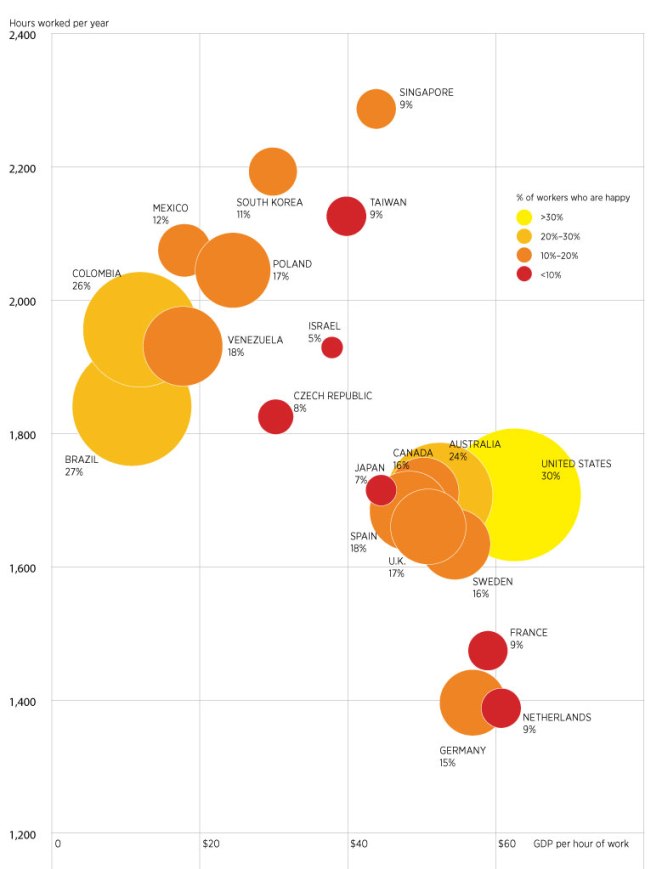
Human resources people worry a lot about worker productivity and “engagement,” a.k.a. happiness. But are the world’s happy workers the most productive? Do they work a lot or a little?
The circles, representing countries, are larger where workers are happier. The horizontal axis shows productivity (GDP per hour worked); the vertical, hours worked per year.
The U.S. is happiest, with 30% of its workforce engaged, while its GDP per hour is a high $63. Outside the U.S. two of the happiest nations–Colombia and Brazil–are not all that productive. The French and the Dutch put in short workdays and boast high GDP per hour, yet fewer than 10% of them are happy.

“What sunshine is to flowers, smiles are to humanity.
They are but trifles, to be sure, but, scattered along life’s pathway, The good they do is inconceivable.”
— Joseph Addison (1672-1719)
Cheerfulness is the gift of sharing warmth and optimism. Sincere good cheer tends to engender happiness, energy, and responsiveness in those around us. This quality may spring from a spontaneous upwelling of joy and good will that cannot be contained; it may also refer to a deliberate choice to focus on what is good and right in the world.
“The most completely lost of all days is that on which one has not laughed.” –– Nicolas Chamfort (1741-1794)
Cheerfulness allows us to move through challenges, assuring us we are capable and resourceful; it tends to increase both the quality and quantity of our years.
“Thus the sovereign voluntary path to cheerfulness, if your cheerfulness be lost, is to sit up cheerfully and to act and speak as if cheerfulness were already there.”
— William James (1842-1910)

“There are two great days in a person’s life – the day we are born and the day we discover why.” – William Barclay
Many of us at one time or another have wondered what we are doing here. This can be both at times when we are having hectic, stress filled days, or at a standstill in a fog of boredom. We have temporarily lost sight of our purpose.
To obtain a healthy purpose in our lives we need a good balance of our time for work, goals, recreation, and relaxation. The daily routine should be examined, a plan established, and then it should be followed.
We can make good use of our time away from work to increase our knowledge of things and life, to work at a hobby or project, and to just relax. There may not be much room to maneuver, say if you are a working single parent, but perhaps a few hours can be found during your hectic week to do something that you want to do.
“I work really hard at trying to see the big picture and not getting stuck in ego. I believe we’re all put on this planet for a purpose, and we all have a different purpose… When you connect with that love and that compassion, that’s when everything unfolds.” – Ellen DeGeneres
Most of us use only a small percentage of our capabilities and can do so much more. Learning new things gives us a feeling of achievement. Reading nonfiction books increases our knowledge and teaches us new skills, but it should be enjoyable. In undertaking a new after hours project do something different from what you do all day at work. Start with something small and complete it, so as not to get discouraged and to get a feeling of achievement when it is done.
“When a man does not know what harbor he is making for, no wind is the right wind.” – Seneca

 Elysian Waters